

Built 1968
The first TR6
Whereabouts unknown
Triumph's two-seat sports car of 1968 to 1976, built at Canley in Coventry: the TR5's chassis under a new nose and tail by Karmann, injected for Britain and Europe as the TR6 PI, carburetted for North America, where the importer wrote it TR-6.
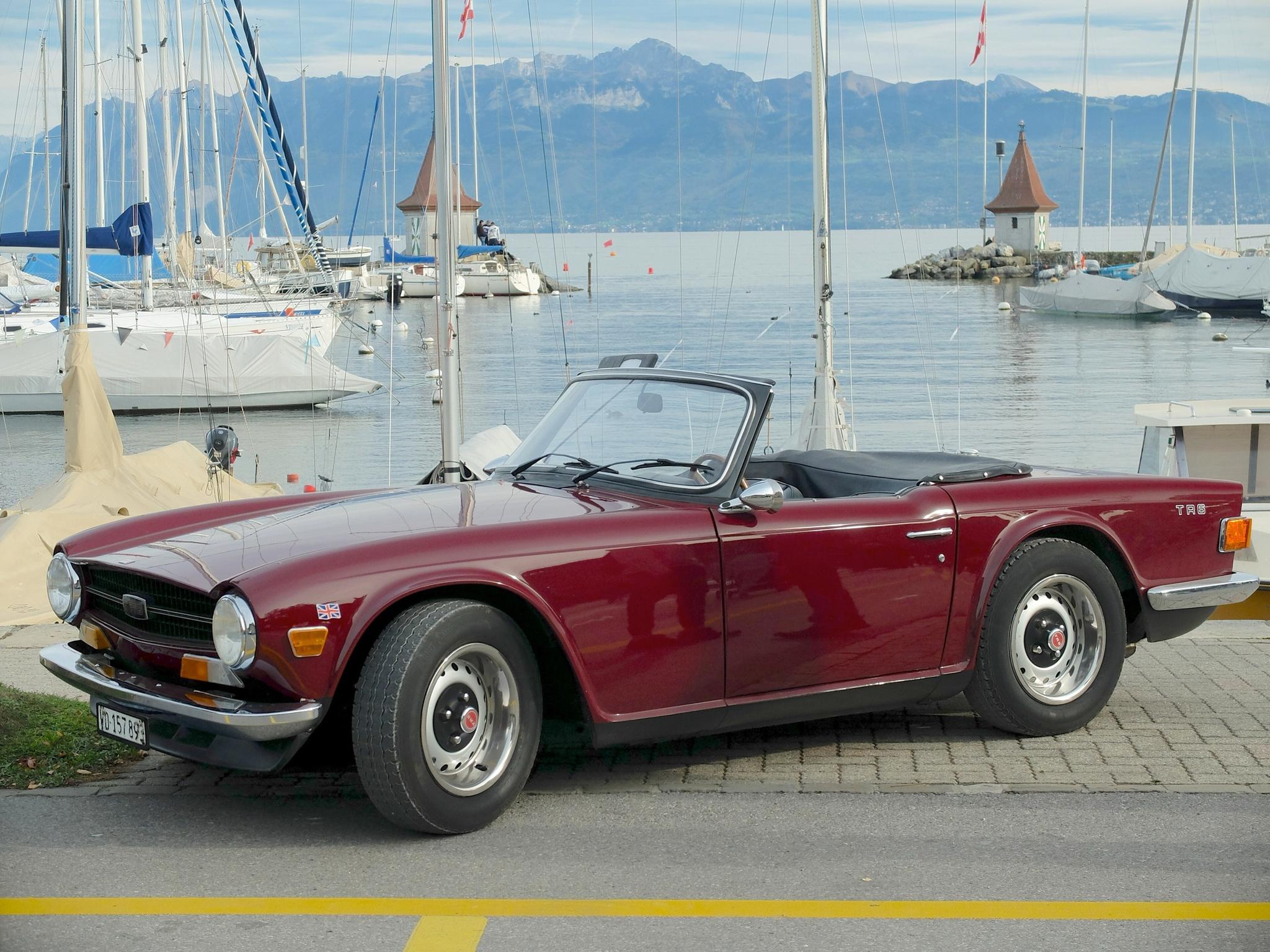
Standard-Triumph had not yet put the TR5 and its American twin, the TR250, on sale when, in the summer of 1967, it decided that they would soon need a new face. It could not afford a new car, and Giovanni Michelotti, who had styled the body the TR5 wore, was busy with other work. Karmann of Osnabrück, in West Germany, got the job: it redrew the nose and the tail and supplied the tooling to make them. The centre of Michelotti's body stayed, and so did the frame, engines and running gear of the TR5 and the TR250.
The first TR6 was built at Canley on 19 September 1968, the day the last TR5 and TR250 were built, and the public saw it in January 1969. Like the cars it replaced, it came in two forms. The TR6 PI, with Lucas petrol (fuel) injection, was built for Britain and for most markets outside North America. The US TR6, for the United States and Canada, kept two Zenith-Stromberg carburettors in its place, and North America took most of the cars.
The car changed in steps over almost eight years. Late in 1972 it gained a front spoiler and new instruments, and the injected engine a milder camshaft; the American cars gained big rubber overriders (bumper guards) for the 1974 model year and, for the 1975 model year, a higher front bumper. In American club racing, Group 44's TR6 won the Sports Car Club of America's D Production championship in 1975, driven by John McComb, and again in 1976, driven by Paul Newman; the TR6's other results are on racing.
The last TR6 PI was built on 7 February 1975, and the last TR6 of all, an American car, on 15 July 1976. No later TR had a separate chassis. The history tells the story in full, and the line-up on this page gives each version's production.source 1source 2source 3source 4source 5source 6source 7source 8source 9source 10source 11source 12
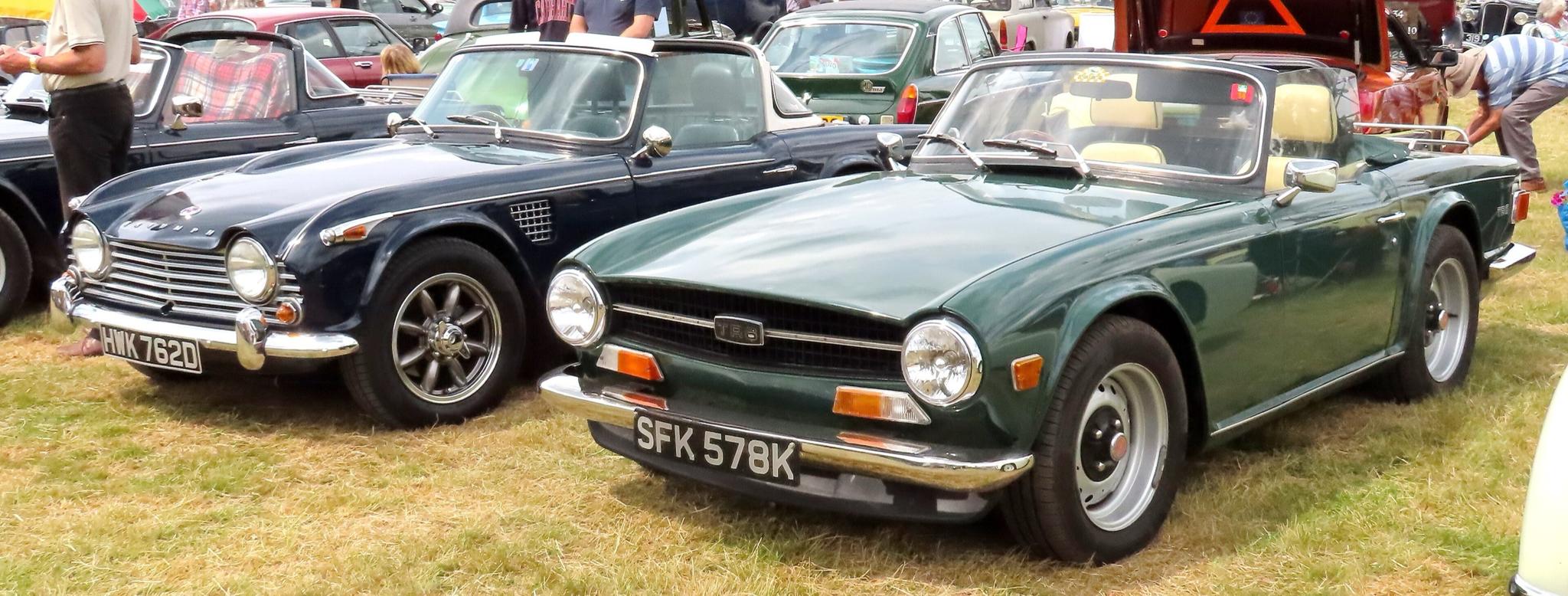
The TR6 had no Marks. Triumph divided it by fuel system and by the prefix of its commission numbers: CP and CR for the injected car, CC and CF for the carburetted one. The second pair of prefixes took over late in 1972, which is why owners speak of early and late cars, and the versions page sets the four series side by side.
The TR6 PI was built with right-hand drive for Britain and with left-hand drive for Europe; in 1973 Motor Sport reported that the cars sold on the Continent were assembled by British Leyland at Malines (Mechelen), in Belgium. The American car kept the TR250's carburettors, with its compression lowered for the 1972 model year. American cars are known by model year, from 1969 to 1976, and the quickest way to date a late one is by its bumpers: rubber overriders from the 1974 model year, and a higher front bumper from the 1975 model year, as on the car in the picture. The production years page takes them one at a time.source 4source 7source 10source 13source 14source 15source 5
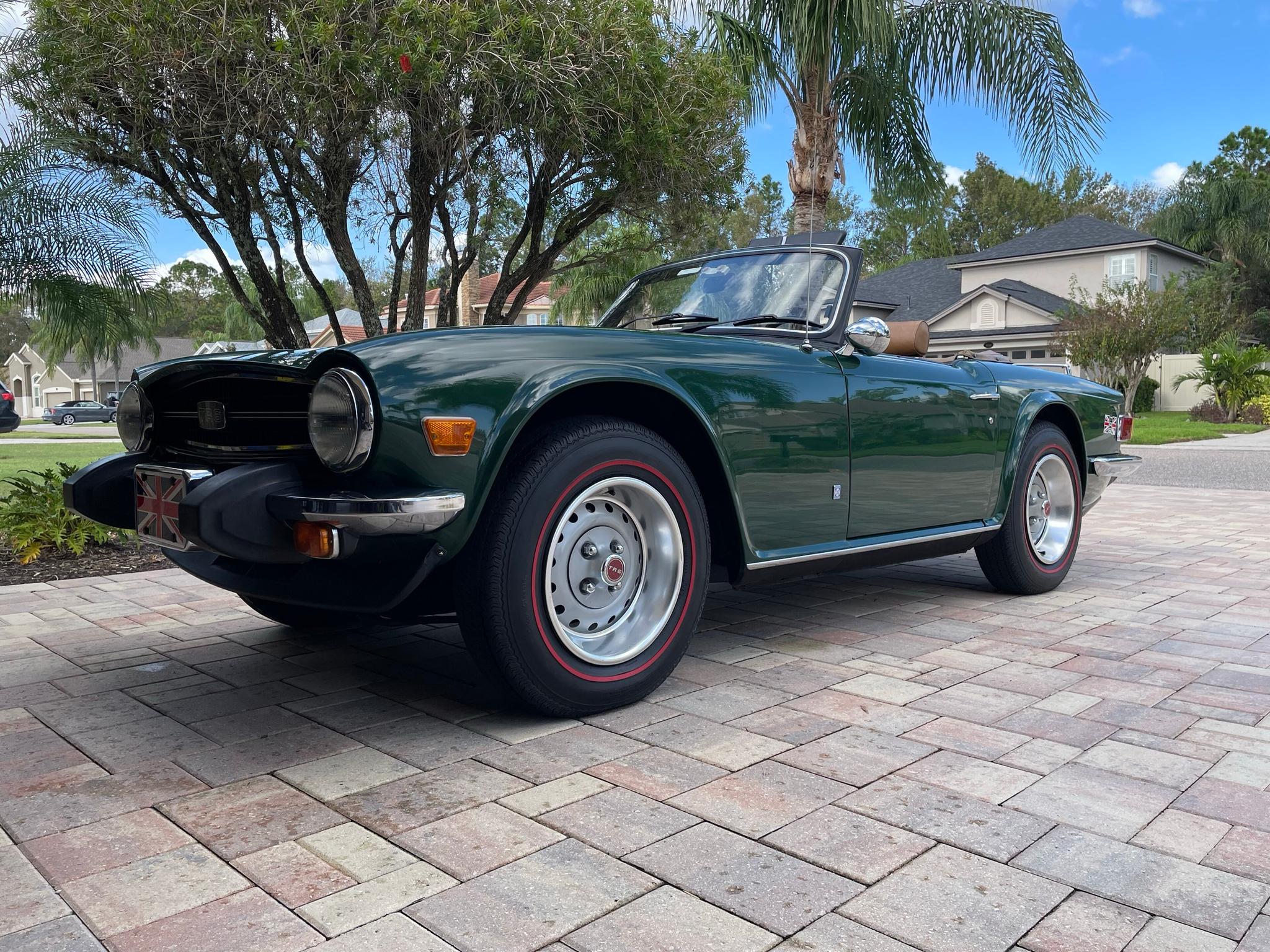
Under Karmann's panels the TR6 was the TR5 and the TR250: it kept their frame, engines, doors and windscreen (windshield) frame, and added wider wheel rims and a front anti-roll bar, which no TR had had before. In 1971 Motor Sport called it "an excellent successor to the Austin Healey 3000", and in America, by Classic & Sports Car's account, it profited when the big Healey went out of production.
Its successor, the TR7, was launched in the United States in January 1975 and sold there beside the TR6, and in 1976 a TR6 beat a TR7 to the D Production title. The TR6's American rival was the Datsun 240Z, new in the same year as the TR6; in Britain, Motor Sport found in 1973 that almost the only open cars at its price were the Jensen-Healey and the Morgan Plus 8. The rivals page sets them side by side.
What the testers made of it is on road tests. For anyone looking at one now, the commission number comes first, because it tells a British car from an American one converted to right-hand drive, as identification explains; the frame comes next, and the buyers guide takes it area by area.source 1source 9source 3source 16source 17source 18source 19source 12source 10source 7
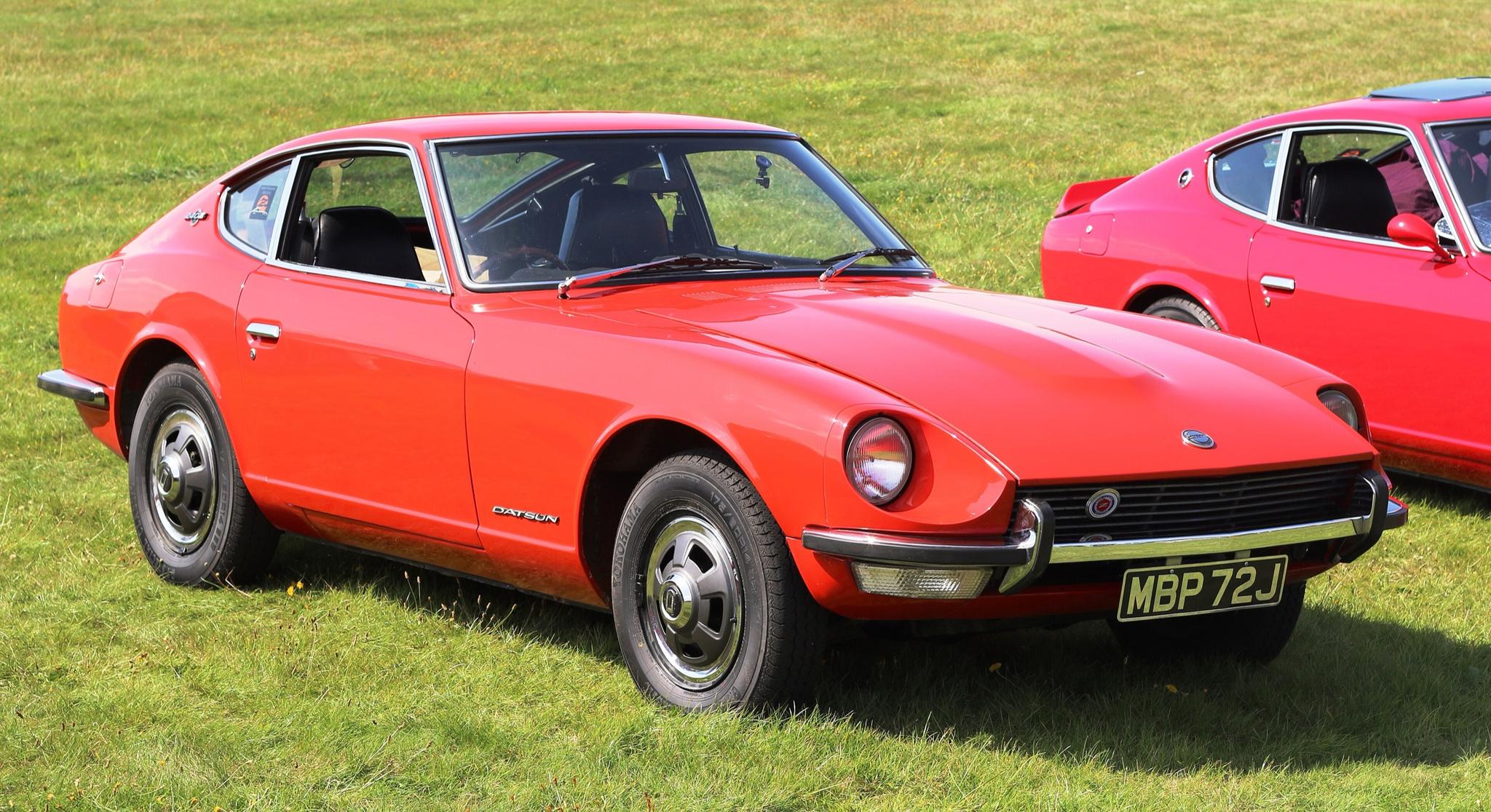
Pictures, top to bottom: Andrew Bone from Weymouth, England, CC BY 2.0; Transpoecon, CC BY-SA 4.0.
Built 1968
Whereabouts unknown
Built 1968
Whereabouts unknown
Whereabouts unknown
Built 1975
Whereabouts unknown
Racing driver for Triumph's US competition department under Kas Kastner. In 1968 he raced its TR250 in SCCA C Production in the West, winning the class at Las Vegas, Lake Garnett and Kent, and drove the TR250K with Bob Tullius in the Sebring 12 Hours. In 1969–70 he drove the US Competition Department's TR-6: his win at Sears Point in March 1969 was the TR6's first in a national race, and he was 3rd in C Production at the 1969 American Road Race of Champions after a pit stop for fouled plugs.
stylist
Aaron Severson names him as a stylist at Wilhelm Karmann GmbH of Osnabrück and the designer of the TR6's restyle, which Karmann took from clay model to production in about a year (TR-Register Deutschland dates the clay model to September 1967); no other source read names him.
service manager, team manager, founder, motorsport manager
American tuner, racer, team manager and author. He began racing in 1952 in an MG TD and opened a tuning shop in Salt Lake City in 1953. The TSOA Newsletter of October 1955 reports an "R. Kastner" winning two races in a TR2 at Cheyenne, Wyoming. In 1959, by the TSOA Newsletter's account, he won the Pacific Coast Class E Championship, the California Sports Car Club championship and the Motoracing West Coast Point Championship in a TR3 he drove to work and to races. After preparing three TR4s that finished 1st, 2nd and 4th in their class at Sebring in 1963 he set up Triumph's US competition department (by his account, no other foreign maker had one there) and wrote Triumph's competition preparation manuals. He finished three of the works TR4s for the 1964 Shell 4000, built the TR4A Super Stock in which Charlie Gates won the 1965 SCCA D Modified title, captained the TR4A team whose cars were 1st, 2nd and 3rd in class at Sebring in 1966, and in 1968 built the TR250K, a prototype on a TR4A chassis, with Peter Brock for Sebring. He was the factory team's guest at Le Mans in 1964 and owned the Macau Spitfire from 14 April 1966 to 2 February 1968. He left Triumph at the end of 1970 and was inducted into the British Sports Car Hall of Fame in its first class, 2017.
Racing driver: 5th in C Production at the 1971 American Road Race of Champions in a TR-6, in his first year with Triumph after several in a Morgan. racingsportscars spells his name Kelly.
chief engineer, technical director
British engineer (1925–2010). He joined Rover in 1945 and became its chief engineer in 1959; the Range Rover (1970) is his best-known car, and he also engineered the Rover SD1. After the 1968 merger he succeeded Harry Webster as Triumph's technical director and led the TR7's engineering. AROnline credits him with developing the 16-valve head; Ate Up With Motor credits it to Lewis Dawtrey.
team driver
Racing driver for Group 44. In 1975, as British Leyland's Triumph team driver, he won the Northeast Division and then the SCCA D Production national championship in Group 44's TR6, at Road Atlanta on 2 November, leading from flag to flag; that September he finished 3rd overall in the Brainerd Trans-Am in the same car. He shared Group 44's TR8 with Bob Tullius and John Kelly in the 1980 Daytona 24 Hours (racingsportscars).
executive vice-president of marketing, marketing executive
A former Rover executive, he became executive vice-president of marketing for Leyland's US organisation after the Leyland–Rover merger of late 1966. According to Ate Up With Motor he pressed for the TR250's brighter colours and nose stripe, authorised the TR250K prototype and later held that it was unsuitable for production. As head of British Leyland's US organisation he judged Triumph's own Bullet proposal dated, disliked the Longbridge design that became the TR7 and opposed the Lynx 2+2; according to Ate Up With Motor, he later told David Knowles that the Lynx was cancelled after he repeated that it would not sell in the US.
TR4 stylist
Turin car stylist. He began his career in 1937 as an apprentice at Stabilimenti Farina; according to carrozzieri-italiani he opened his own design studio in Turin in 1949, the first in Italy devoted only to car design; the TSOA Newsletter of 1966 also dates the studio to 1949. His first contact with Standard-Triumph came in 1957: Harry Webster's obituary in the Telegraph says Webster "discovered" him, while Graham Robson says he was found through Raymond Flower and hired on Webster's recommendation with Alick Dick's approval. His first Triumph design was the one-off TR3 "Dream Car" on a TR3 chassis, shown at Geneva in 1957 according to later accounts; Krause says it followed a chance meeting with Alick Dick at a motor show. He went on to design the Italia (1959–62) on TR3A and TR3B running gear. On his own initiative he drew a one-off body for a BMW 507 chassis, shown at the Turin show in 1959, which BMW has owned since 2005. He styled the Herald (1959), whose separate chassis made the Spitfire possible; answering Webster's idea of a "Herald sports car", he built a single prototype in 1960, code-named "Bomb", and later restyled the car as the Mk IV of 1970. For the TR he styled the prototypes Zest (1958) and Zoom (1959) and the TR4 of 1961, which joined Zest's nose to Zoom's tail and kept Zoom's hardtop with its lift-out panel; the TR4A, TR5 and TR250 kept that body with new detail, and its centre section on the TR6 (1969), whose new front and rear Karmann designed because he was busy. According to his son Edgardo, his work for Triumph ended in the late 1970s with a restyle of the TR7 from coupé to spider; he died in January 1980. No source read links him to the Le Mans or Macau competition bodies.
SCCA national champion in a Spitfire (F Production, 1969) and in a TR7 (D Production, 1979). In 1974–75 he drove Huffaker Engineering's V12 E-Type in SCCA B Production, winning on its debut at Seattle in August 1974.
Actor and racing driver. On 31 October 1976 at Road Atlanta he won the SCCA D Production national championship from pole, by 0.84 seconds from Lee Mueller's TR7, in a Triumph TR6, the car in which John McComb had won the same title a year before, and received the SCCA's President's Cup that night. Severson notes the result was "somewhat awkward" for British Leyland's US organisation, since the TR6 had beaten the new TR7.
TR-6 racer: the Southwest Division's C Production winner in 1973 and 7th at that year's SCCA runoffs, the only TR6 to finish; 3rd in D Production at the 1975 runoffs behind John McComb's Group 44 TR6.
Racing driver for Kas Kastner's teams: runner-up in D Production at the 1970 American Road Race of Champions in a Kastner-prepared GT-6, and 6th in C Production at the 1972 event in Kastner-Brophy's TR-6.
founder, driver
American racing driver. He bought a TR3 in 1960 and raced from 1961. In TR4s he won the SCCA national E Production championship in 1962, Triumph's first national class title by the importer's account, and D Production in 1963 and 1964; Triumph gave him one of Kas Kastner's Sebring TR4s. With Brian Fuerstenau and Dick Gilmartin he founded Group 44 Inc. in 1965; it won 14 SCCA national titles and three Trans-Am championships before closing in 1990. In 1968 he raced Group 44's TR250 in SCCA C Production. By the importer's count in September he had six wins in the Northeast Division, enough for at least a tie for its title, and three outside it. He was 3rd in C Production at the ARRC, and he co-drove the TR250K at Sebring. From 1969 to 1974 he raced Group 44's TR-6 in SCCA C Production, 2nd at the 1972 American Road Race of Champions, and showed it on British Leyland's stand at the 1972 London Motor Show; Severson writes that the last TR6 built went to him. In 1974–75 he raced Group 44's V12 E-Type in SCCA B Production: 2nd at the 1974 Runoffs by 0.8 s, and national champion in 1975. He had won the SCCA Trans-Am drivers' championship in 1977 and 1978 with a Jaguar XJ-S. From 1979 to 1981 Group 44, Jaguar Rover Triumph's official US racing team, raced the TR8 in IMSA and the Trans-Am. It won its class on the car's debut, the Watkins Glen 6 Hours of July 1979; Tullius won his class four times in 1979, in IMSA GTO and the Trans-Am, as Car and Driver and Lamm count them, and Group 44's No. 44 won the IMSA GTO class four times in 1980. British Sports Car Hall of Fame, first class (2017).
Every source the site cites is on the sources page.